

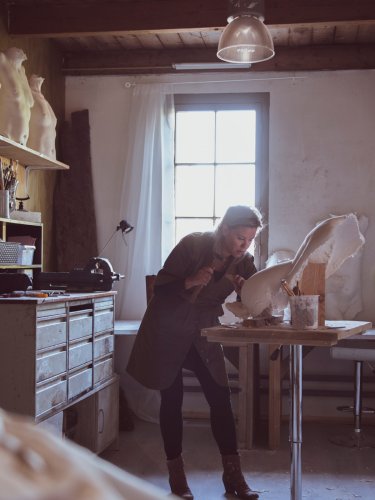
As an artist, I had to find my own path. A path without a fixed framework or imposed vision. I am proud of that. Precisely because I was not shaped within a rigid system, I was able to develop my own visual language, my own pace, and my own perspective on body art. That does not mean I stood still. I studied, traveled, and over the years completed various courses and training programs, both in my home country and abroad, all focused on bodycasting and related techniques. Every step and every deepening helped me grow technically as well as artistically. This autonomous development forms the foundation of my work today.
At the same time, I truly had to detach myself from the technique in order to fully make it my own and shape it in my own way. Bodycasting has existed for centuries and is often seen as something purely technical. You make a mold of a body, you cast it, and you are done. As if the final result is predetermined. But that has not been how the process has worked for me for a long time now.
In my early years, roughly between 2005 and 2012, I worked almost exclusively on commission. A client would come to me with a concrete request, and I would carry it out. I created body casts exactly as requested, with care, attention, and technical precision. It was solid craftsmanship, but the process was primarily service oriented. During that period, I saw myself more as an executing maker than as an autonomous artist. The outcome was largely predictable and directly linked to the client’s request.
Around 2012 and 2013, something slowly began to shift. Not abruptly, but almost unnoticed. I started to look more deeply. Not only at what a client literally asked for, but at what lay beneath that request. Emotion, meaning, memory, loss, or connection. At the same time, I increasingly asked myself another, perhaps more challenging question. What do I actually want to create? What do I want to add? What do I want to express through my work?
That inner dialogue created space. Space to deviate from the commission without doing it injustice. Space to refine, alter, remove, or add elements. I began experimenting with multiple casts, second, third, and even fourth pours. The original body gradually became less of an endpoint and more of a starting point for a process.
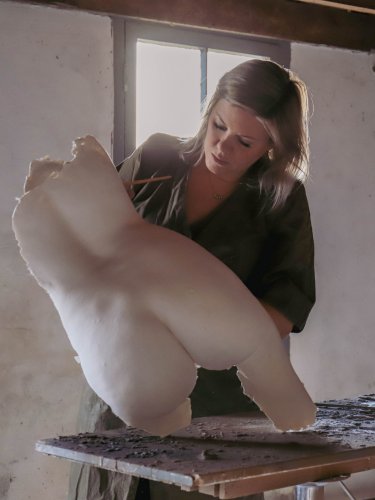
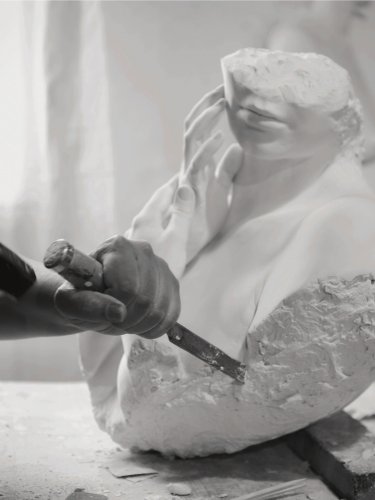
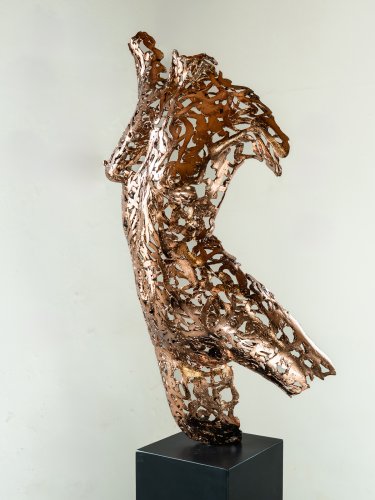
My sculptures began to detach themselves from the model. I sculpted, cut, carved, deformed, softened, and reinforced forms. Sometimes very little remained of the original imprint, except for a memory of a shape, a movement, or a feeling. What emerged was no longer a reproduction, but a distinct visual language. My visual language.
The sculptures that resulted began to receive attention. More and more people showed interest in owning a free work created by my hand. That continues to surprise me and sometimes even humbles me. That there are people who find my thoughts and creations beautiful, understand them, and want to acquire them. It is extraordinary to experience that my work is not only seen, but also understood and loved. It feels like a quiet affirmation of the path I have chosen.
Today, my practice consists roughly of half free work and half commissioned work. That balance feels very natural. There are still many people who come to me with the wish to have a personal, bespoke sculpture created, and I create commissioned works with great care and dedication. This can be done using the client themselves as a model or working with one of my models. Over the years, I have built a carefully curated archive of models, allowing me to select precisely what suits an idea or form.
Whatever the starting point, I always work from my own signature. This style has developed over time and has become recognizable. It is precisely within that framework that the freedom to create custom work exists. I find it special that people place their trust in me to translate their story, their body, or their idea into my visual language. It shows that craftsmanship and autonomy can exist side by side without limiting one another.
In addition, I find it deeply meaningful to pass on the technique that I have refined and developed so carefully over the years. Together with my husband, I founded the Bodycasting Academy in 2017. Through this academy, we train and inspire people worldwide, introducing them to bodycasting and lifecasting, materials, and possibilities. Many participants aspire to start their own bodycasting studio or gallery in their own region or country. I enjoy thinking along with them, supporting them, and encouraging their enthusiasm for this profession.
At the same time, I am very aware that I bring more than twenty years of experience, while many participants are only at the beginning of their journey. That journey is a valuable one, and I guide people with honesty and care. Sometimes it becomes clear along the way that the profession is more complex or demanding than initially expected. Precisely for that reason, the Academy offers space to observe, ask questions, reflect, and deepen understanding. We regularly work with models and offer various modules in which participants grow step by step in knowledge, skills, and perhaps most importantly, in freedom of thinking and seeing possibilities.
That people now recognize, follow, and value my work feels like a confirmation. Not only of my abilities, but above all of my development. Within a craft, it is possible to grow toward autonomous artistic practice. It can deepen, transform, and free itself from an original function, whether that function is material, technique, or purpose. And sometimes, very gradually, it grows into art.
With love, Petra
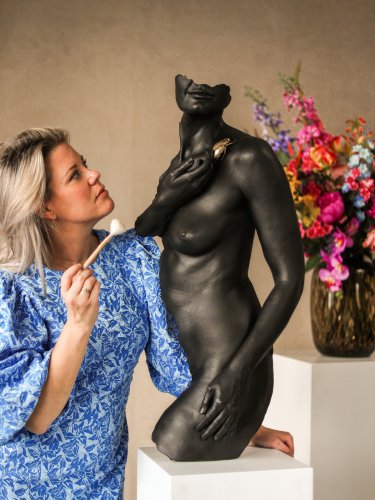
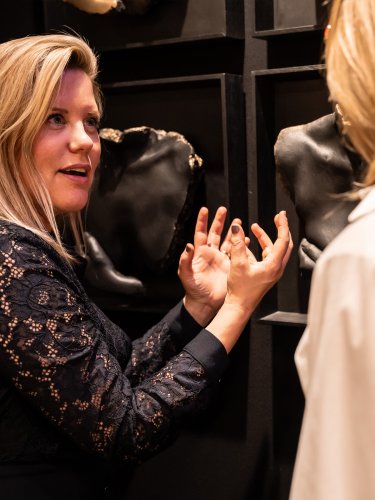
Frenzy behind the scenes of high end events Those who know my work usually see only the final result: a beautiful presentation, perfect lighting, and sculptures that seem to glow as if they were made especially for that space.
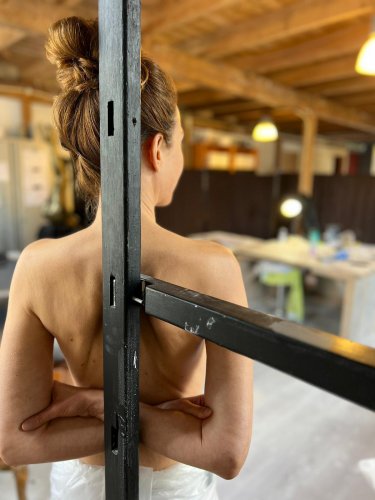
For more than twenty years, I have had the privilege of supporting women during one of the most profound periods of their lives.
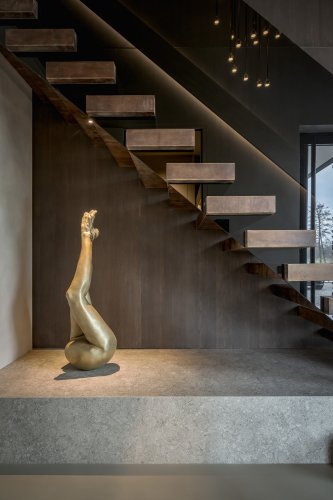
In many interior projects, art is only considered at the very end, almost as a final styling layer. Yet I notice that when a work of art is introduced from the beginning, it can give direction. It can determine the energy of a space, tell a story, and touch something that does not need explanation.
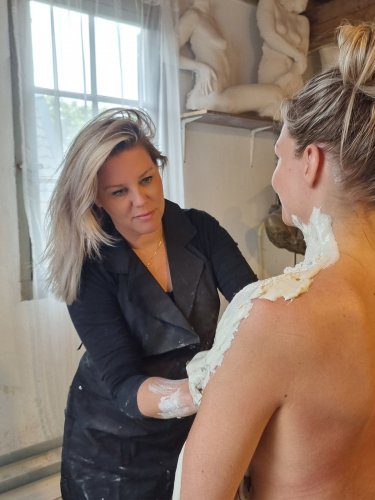
For me, art always arises from a deep fascination with the human body. The lines, the tension, the stillness, the strength. It is an endless source of forms that I capture in sculptures. In my free work, I allow myself to be guided entirely by my own intuition and artistic compass.



Burgemeester Le Coultrestraat 3 • 2411 EP • Bodegraven-Reeuwijk • The Netherlands
Tel: 0172 - 74 89 28 • Email:
info@petraflach.com



Burgemeester Le Coultrestraat 3
2411 EP
Bodegraven-Reeuwijk
The Netherlands
Tel: 0172 - 74 89 28
Email:
info@petraflach.com
© 2013 - 2026 Petra Flach | Ontwerp & realisatie: De Goudse Wolf